
LABOUR MARKET / MACRO RESEARCH
How to read NFP: jobs, wages and revisions
MDS MACRO editorial team · published · methodology updated
Key takeaway
Assess NFP alongside revisions, wages and unemployment. The question is whether the labour market was genuinely stronger than expected, not simply whether jobs increased.
Two surveys, different questions
Payrolls measure jobs in an employer survey. Unemployment is measured in a household survey. The samples and observation units differ, so payrolls and unemployment can rise simultaneously. Do not choose one figure and declare the other wrong.
Read the package in the right order
Start with NFP's deviation from consensus. Then review prior-month revisions, the distribution of employment, wages and the workweek. Next, examine unemployment and labour-force participation. Changes in average earnings may reflect workforce composition as well as individual pay rises.
Illustrative MDS example — not a real release
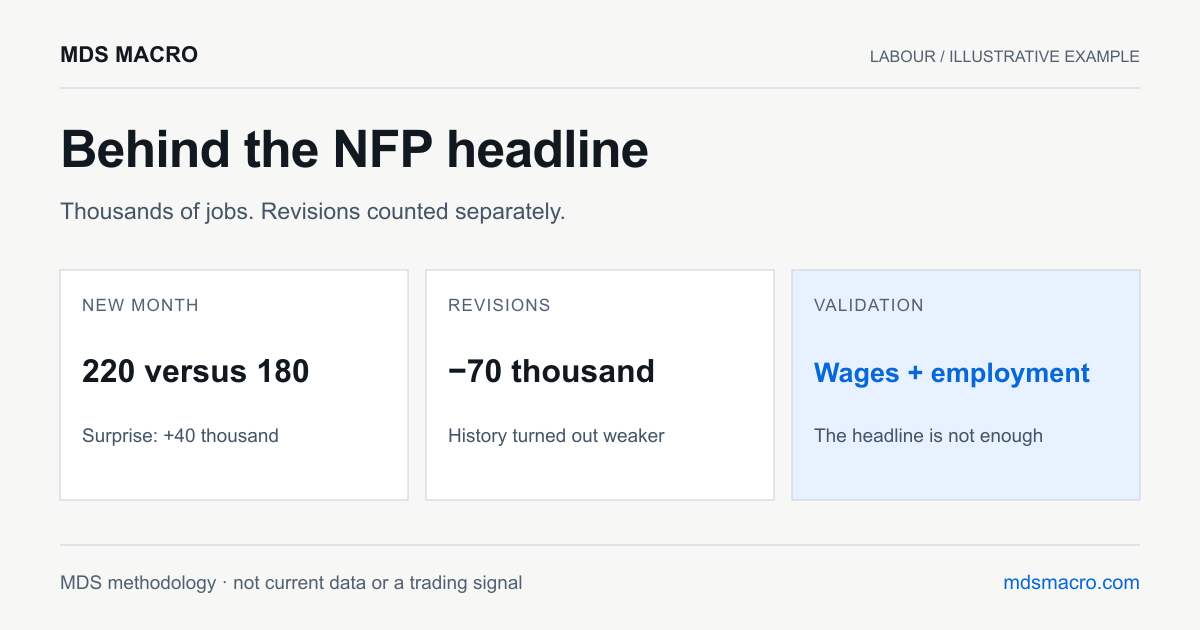
Suppose NFP rises by 220,000 against a 180,000 forecast, but the preceding two months are revised down by a combined 70,000. The new 40,000 surprise coexists with weaker history. Their simple sum of -30,000 is useful arithmetic, not a complete package surprise, because expectations for revisions are unknown.
Historical case: April 2020
The BLS report dated 8 May 2020 recorded roughly 20.5 million fewer payroll jobs and 14.7% unemployment in April. Both surveys deteriorated, illustrating the scale of the pandemic shock. The archive notes a payroll correction on 11 May and subsequent amendments. It is not an untouched snapshot of the release's first second.
Open the official document ↗Working conclusion
If employment, wages and revisions consistently beat expectations, there is less reason to expect rapid easing based solely on labour-market weakness. If the package conflicts, say so explicitly. For USD and gold, check whether policy expectations and yields changed rather than mechanically applying NFP's sign to price.
MDS / CHECK THE CALCULATION
Explore with your own inputs
Default values come from this article's illustrative example. Change them to check the arithmetic. They are not current market data.
Arithmetic sum: -30 thousand. This is not a complete package surprise because expectations for revisions are unknown. Wages and unemployment are not included in this calculation.
Sources and data limitations
The historical case uses the current archived BLS document with its noted corrections. It is not used to calculate returns or forecasting accuracy.
BLS · April 2020 employment · released 8 May 2020, with correctionsHistorical facts were checked against the cited official document. Illustrative numbers, calculations and explanations are the MDS methodology, not current data or a test of strategy profitability. The methodology date does not change when the calendar synchronizes automatically.