
MONETARY POLICY / MACRO RESEARCH
Rates and yields: what really changes the macro backdrop
MDS MACRO editorial team · published · methodology updated
Key takeaway
The same rate decision can produce opposite reactions. What matters is the gap between the expected and new policy paths and, for a currency pair, the relative shift between its two economies.
Decisions and expectations are different
A central bank announces the current rate or target range. Instrument prices also reflect expectations of future decisions. An expected hike may therefore barely move markets, while a hold accompanied by unexpectedly hawkish guidance may have a larger effect.
Do not mix instruments
A bond yield is not the central bank policy rate. It depends on expected short-term rates and risk premiums, so its entire change cannot be attributed to expectations for one meeting. Nominal and real yields also differ. Higher real yields can make alternative assets more attractive relative to gold, but they are not its only price driver.
Illustrative MDS example — not a real meeting
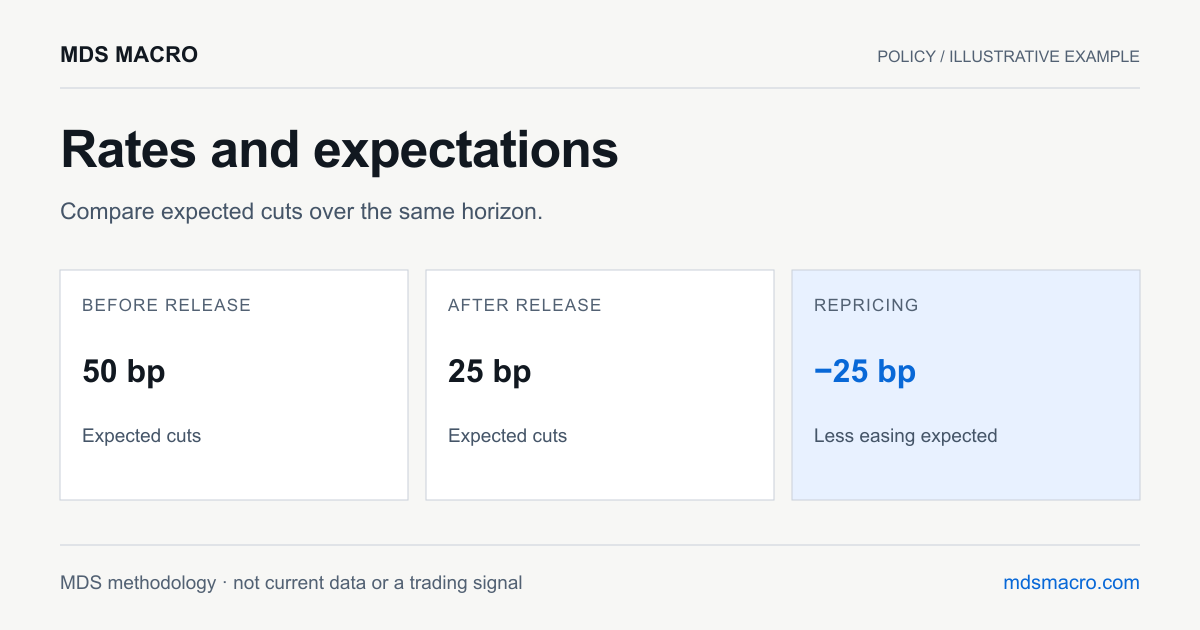
Suppose markets expected a hold today and 50 basis points of cuts over the coming months. Today's decision matches expectations, but new signals reduce priced-in cuts to 25 basis points. The current rate is unchanged, yet the expected path is more hawkish. That shift can support the currency.
Historical case: Federal Reserve, 15 June 2022
The Fed set a 1.50–1.75% target range and indicated that further increases would be appropriate. It also continued reducing its bond holdings. The document illustrates three separate policy elements: the current level, the future path and the balance sheet. A statement alone cannot quantify the surprise without a saved pre-meeting market assessment.
Open the official document ↗How we form a conclusion for a currency pair
For EURUSD, compare changes in Fed and ECB expectations on comparable horizons. Saying US rates are higher is insufficient because this may already be priced in. A useful conclusion identifies which side gained new evidence, what confirms it and which upcoming release could change it.
MDS / CHECK THE CALCULATION
Explore with your own inputs
Default values come from this article's illustrative example. Change them to check the arithmetic. They are not current market data.
On the same horizon, fewer cuts are expected. The path has become more hawkish even if the current rate is unchanged.
MDS / CALENDAR DATA
Confirmed releases in the available snapshot
Only published values with a stated reference period and a link to an agency document. General calendar pages are excluded. This is the available snapshot, not the agency's full archive.
| Indicator and period | Actual | Forecast | Previous | Difference |
|---|---|---|---|---|
| BoE Interest Rate Decision · GBPUnited Kingdom · period 2026-09-17 17/09/2026, 13:00 CESTSource | 4% | 3.75% | 3.75% | +0.25 pp |
| Federal Funds Rate · USDUnited States · period 2026-09-16 16/09/2026, 20:00 CESTSource | 4% | 4.00% | 3.75% | 0 pp |
| Official Bank Rate · GBPUnited Kingdom · period 2026-07-30 30/07/2026, 13:00 CESTSource | 3.75% | 3.75% | 3.75% | 0 pp |
| Federal Funds Rate · USDUnited States · period 2026-07-29 29/07/2026, 20:00 CESTSource | 3.75% | 3.75% | 3.75% | 0 pp |
Difference = Actual − Forecast within the same series. The forecast is the saved calendar consensus. The official document confirms the actual, not the consensus. Initial releases and subsequent revisions may differ. Future and unconfirmed values are not shown here.
Sources and data limitations
The historical target range comes from the Fed's statement dated 15 June 2022. The illustrative rate-cut path above is fictional and does not describe that meeting.
Federal Reserve · FOMC statement, 15 June 2022Historical facts were checked against the cited official document. Illustrative numbers, calculations and explanations are the MDS methodology, not current data or a test of strategy profitability. The methodology date does not change when the calendar synchronizes automatically.